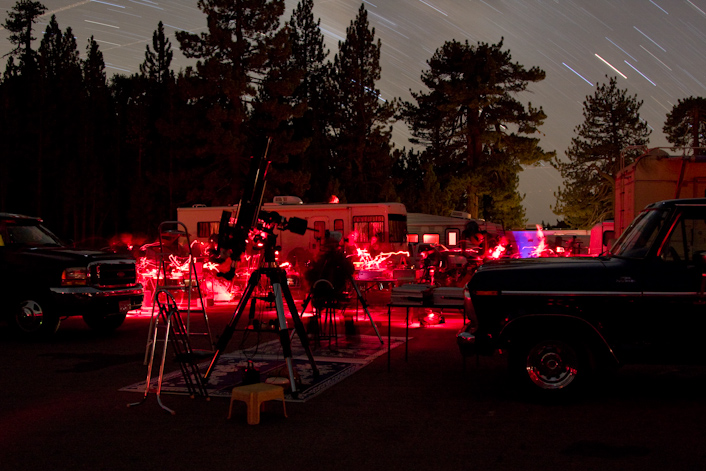
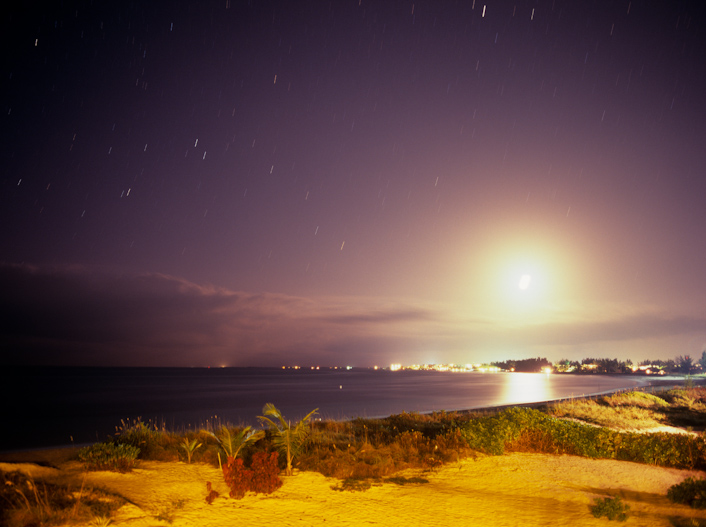
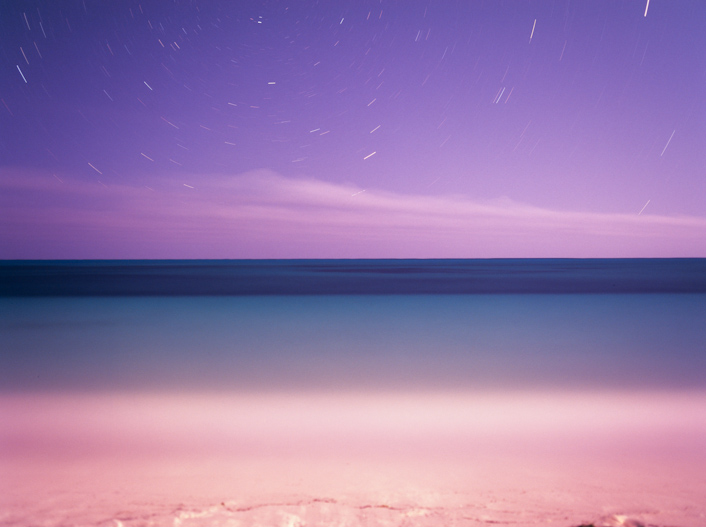
One thing I’ve found to be intriguing about night-time photography is the phenomenon of “star trails.” Star trails are created by leaving the camera shutter open for long periods of time to let the light of stars paint across the film. The effect is no different than any other long exposure side effect, with the exception that the movement represented is the rotation of the Earth rather than of the camera. Depending on the composition, this can produce some interesting results. Star trails can be seen in exposures as low as 30 seconds. However the more dramatic trails require exposures of an hour or even longer.
An hour of the night, Lake Tahoe, CA 2006Star Trails and Clouds, Mt. Pinos, CA 2007Astronomers and Star Trails, Mt. Pinos, CA, September 2008Star Trails over Providenciales with half Moon, Turks and Caicos Islands November 2006Star Trails over the Caribbean, Turks and Caicos Islands November 2006
This short sequence of frames shows the progression of star trails in exposures of 5 to 30 minutes.
My childhood fascination with trains has led me on many photographic adventures. In Southern California, there are many opportunities to see and experience the wonders of railroads, whether by taking a Metrolink or Amtrak train ride or visiting any number of local tourist destinations and museums. Through some searching online I discovered the Orange Empire Railway Museum in Perris, CA. This fantastic museum offers a range of activities and sights for the railroad enthusiast, and the avid photographer. With this group of shots I’m focusing on a less than obvious side of railroad equipment I saw at the museum. I’m speaking of the infinite array of textures presented by the range of locomotives and rolling stock on display at the museum. It’s pretty easy to get overwhelmed by the big things around you that you might sometimes miss the smaller things right in front of you. In this case I realized that many of the old freight cars around the museum grounds offered some fascinating textures to explore photographically. These images are a few of the results.
ROXSuspensionTank Car BrakePainted Texture IIARCOBrake Shadow
God rays shine from between the clouds over a dark Pacific
A couple years ago I was on an exploratory trip down to the Palos Verdes area. I drove down there as a random photo trip to see what could be seen. Eventually while driving on Palos Verdes drive I ran into Point Vicente Lighthouse. Adjacent to this lighthouse was a reception area for weddings and events, and a nice path that went right along the cliff. This is where I headed to take pictures.
Point Vicente Lighthouse
What struck me first about this location was the weather that was happening. A prime motivation for going on this photo trip was the fact that we were getting some clouds and weather in the LA area that day. The lack of weather here can sometimes make photographing the surrounding landscape a bit dull. Looking out over the Pacific this day yielded a dramatic scene. In Visual Effects, we generally refer to the beams of light shining down like such as these as “god rays.” In fact there are plugins for software that can generate them. With my photography however, I keep everything real. These god rays were right there before my eyes and captured in camera.
Interplay of light and dark
After taking a few pictures I realized a time lapse sequence would be really cool. Here is the result with one frame taken every 10 seconds:
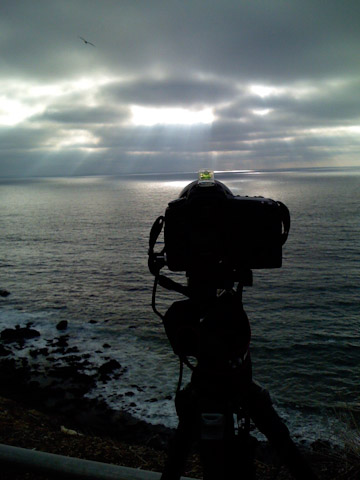
I wish I would have done one frame every 2 seconds, and that I had let it go longer. Here is an iPhone pic of the camera taking the time lapse:
Rig for this time lapse: Canon 20d on Manfrotto 055MF4
After a long week, I’ve finally had a chance to sit down and add a few more photos from the Station Fire shoot last weekend. Fortunately the fire no longer threatens any homes. Thinking about the fire I have realized that the station fire has burned through areas I hiked just a few months back. I have several GPS tagged photographs from various parts of Josephine Peak, Strawberry Peak, and Colby Canyon. Perhaps when the area is made accessible again I can return and take “after” photographs of the burn area, matching location, lens and views of my earlier photographs. I expect the result will be incredibly dramatic. I have no idea if the area will be reopened for hiking anytime soon.
In the meantime though, here are a few more photos from the Station fire.
The smoke plume looked like a volcano eruptingThe setting sun casts an eerily beautiful orange glow onto the plumeBacklit photographer sticking out of the grassThe extent of the fire is revealed at dusk as onlookers gaze and snap photosA part of the fire flares up at duskFirefighters on the hillside above the JPLHere is a 100% size crop showing the firetrucks
The next post will focus on some less destructive images.